A systems approach to nature-inclusive agrifood transitions
Restoring biodiversity requires more than isolated interventions. Farming is shaped by interactions between ecosystems, business decisions, value chains, spatial conditions, institutions, and society. RISE therefore combines ecological research, systems thinking, modelling, spatial analysis, and participatory co-design to understand these connections and translate them into actionable strategies.
Working closely with stakeholders in Reusel-Zuid and Oostland Zuid-Holland, we follow an iterative learning process in which new insights continuously inform our understanding, models, and strategies.
1. Understand the system
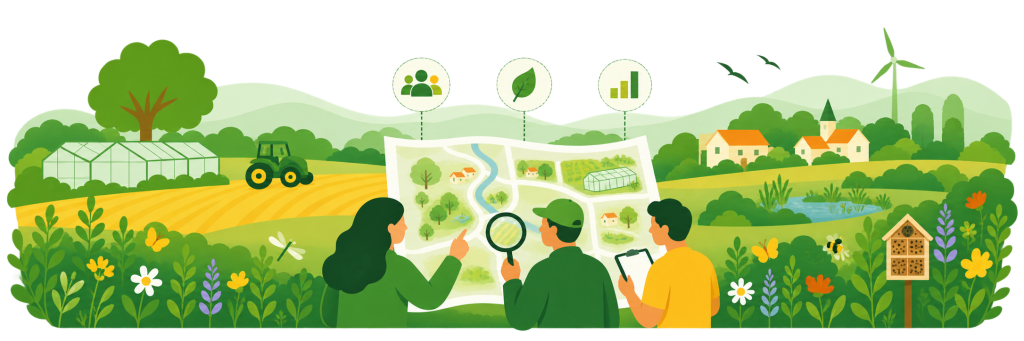
Every region is unique. We begin by building a shared understanding of how the regional agrifood system functions.
Together with farmers, businesses, policymakers, and other stakeholders, we map the ecological, social, and economic context. By exploring relationships between biodiversity, farming practices, markets, institutions, and local communities, we identify the barriers, incentives, dependencies, and opportunities that shape nature-inclusive decision-making.
2. Measure & model dynamics
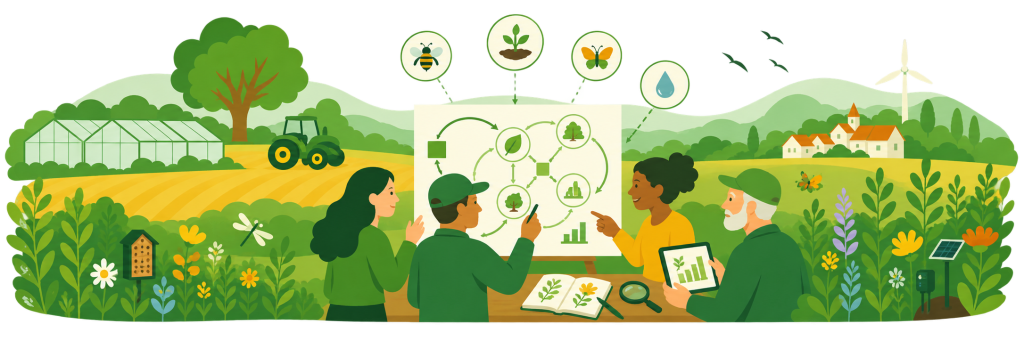
Understanding a system requires evidence. RISE combines biodiversity and ecosystem-service monitoring with social and economic indicators to assess both ecological impact and practical feasibility.
These data are integrated into participatory system dynamics and spatial models, helping stakeholders understand connections, feedback loops, and the long-term effects of management decisions across the wider landscape and over time.
3. Explore futures & co-design pathways
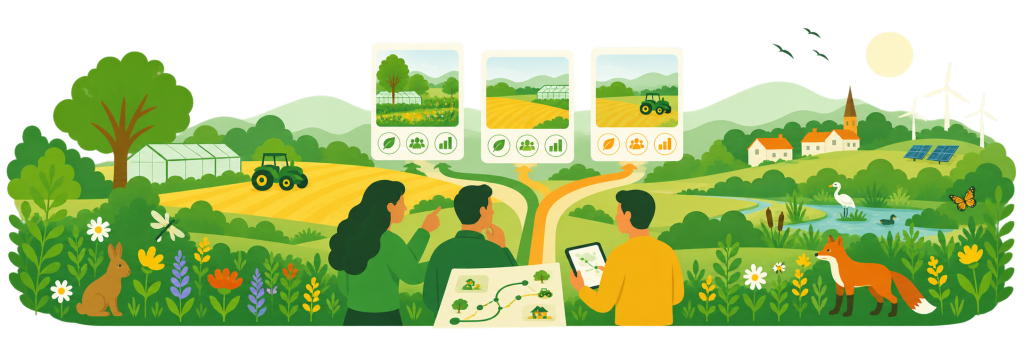
What happens if we implement changes? Which interventions create the greatest benefits for both nature and agriculture?
Using the models, stakeholders can explore different future scenarios in a safe and transparent environment. Together, we assess trade-offs, identify opportunities, and co-design implementation pathways that combine technological, economic, policy, and social acceptance.
4. Validate, learn & scale
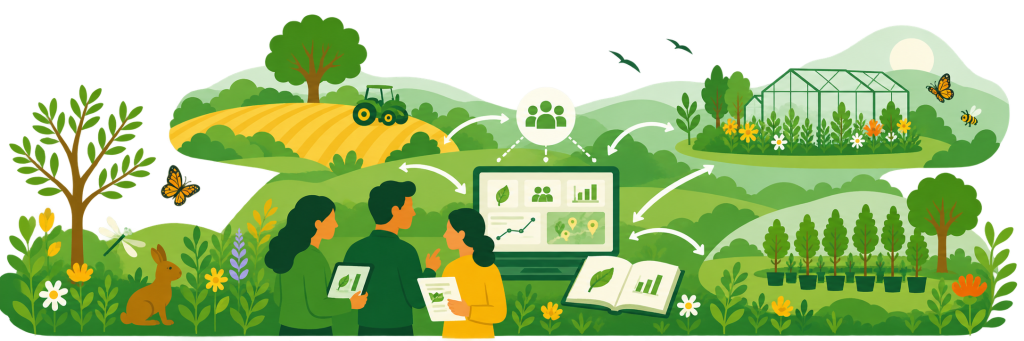
RISE aims to create solutions that work beyond individual case studies.
RISE is designed to generate solutions that are locally grounded without remaining locally confined. Tools, models, and implementation pathways are continuously tested and refined with stakeholders in the two case regions. In the final phase, the approach will be validated in a third independent region. The lessons learned will be translated into an open-source platform and replication framework, enabling other regions to adapt and apply the RISE methodology.
From understanding to action
Across all four stages, co-creation is central. RISE does not simply develop solutions for regional stakeholders, but develops them with them. By combining scientific knowledge with local experience and bringing ecological, economic, and societal perspectives together, we aim to make nature-inclusive decisions both desirable and feasible in practice.
Papers & Output
Come back soon!